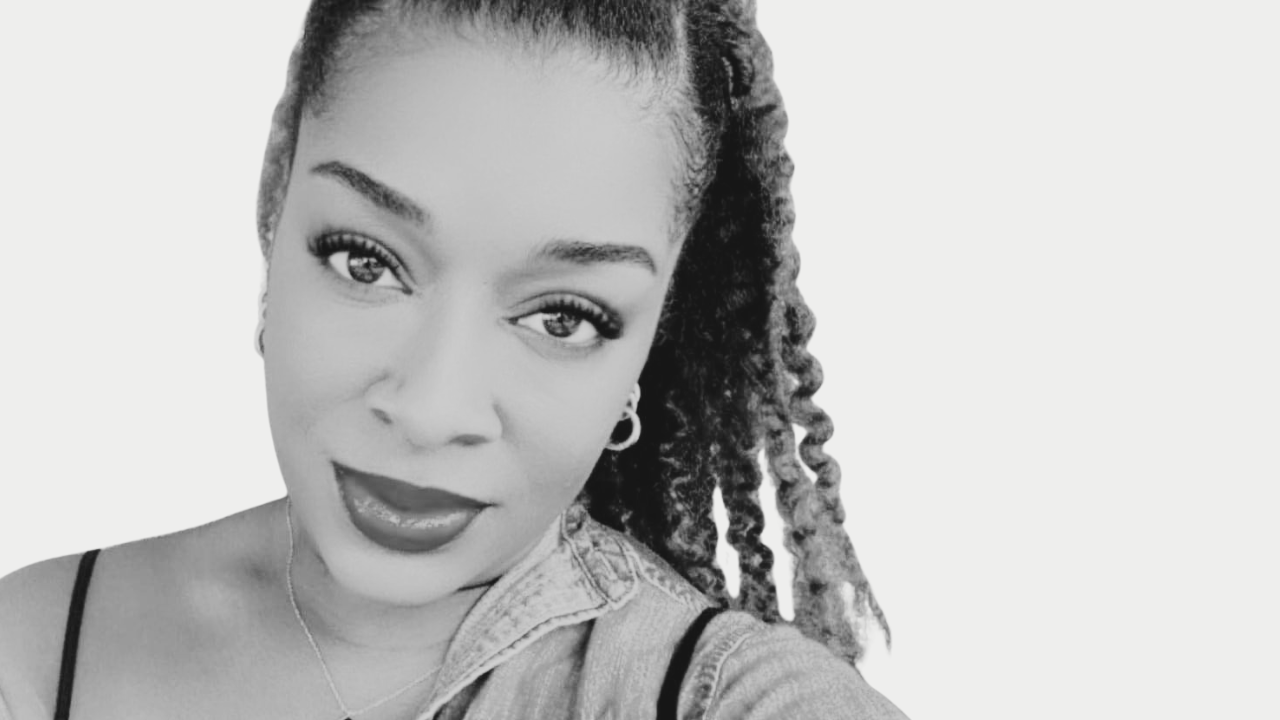
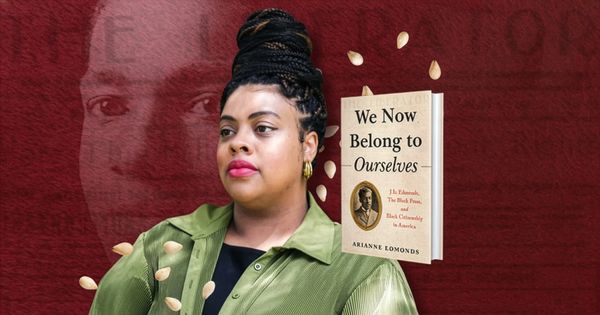
When Arianne Edmonds speaks about lineage, her voice carries both urgency and reverence. A fifth-generation Angeleno, writer, and memory worker, she has made it her life’s work to piece together the fragments of stories often scattered, suppressed, or left to gather dust on family shelves. That work comes to life in her debut book, We Now Belong to Ourselves (Oxford University Press, 2025), a blend of memoir, archival storytelling, and cultural analysis.
The book takes its title from a phrase her great-great-grandfather, Jefferson Lewis Edmonds, embodied long before she set pen to page. Jefferson was born enslaved in Mississippi in 1852, lived through Reconstruction, and later became the editor of The Liberator, one of Los Angeles’s earliest Black newspapers. Through his pen, he urged Black Southerners to move west, to claim new freedoms, and to imagine joy beyond survival. More than a century later, his descendant has picked up that call—not only to remember but to repair.
“I really look at narrative change from a very holistic perspective,” Edmonds told Binamu in an interview. “When I think about this book, and the way that Jefferson worked in concert with other editors and writers around the country, he created an ecosystem. He created an opportunity for folks to be brought in and co-create what the new change should look like together.”
For Edmonds, narrative change is about pausing, taking stock, and asking a deeper question: Who do we say we want to be?
Narrative Repair as Liberation Work
In professional settings, “narrative change” is often used as shorthand for shifting public opinion on a social issue. Edmonds doesn’t dismiss that—she’s worked on campaigns involving traditional media, strategists, and op-eds—but her definition goes further.
She grounds her approach in Jefferson’s example at the turn of the twentieth century, when he used The Liberator to connect newly emancipated Black Americans, encourage civic engagement, and create visions of belonging that were equal parts practical and aspirational.
In his pages, one could find political commentary alongside community announcements about weddings or the “Don’t Worry Club” of Santa Monica. It was a deliberate choice to record not just the struggle, but the sweetness of Black life in Los Angeles.
“Jefferson had already been enslaved, lived through Reconstruction, and gained the right to vote,” Edmonds explained. “They would have these town halls and invite people from all over the South to move to California and create a new world. So when I think about narrative change, I don’t see it as a strategy to convince people. I see it through the lens of Jefferson and his contemporaries, which is: we’re going to co-create what this looks like, and we’re going to do it together.”
Writing Across Time
If We Now Belong to Ourselves feels expansive, it’s by design. Edmonds wanted readers to move fluidly between the past and the present, between the living and the dead.
“I actually didn’t struggle weaving it all together,” she said. “I felt pressure to write a historical biography and focus on Jefferson’s life. But something about that felt unnatural to me. Mainly because I didn’t want this to be just an academic book. I wanted folks to feel like Jefferson and I were in lockstep."
That vision required her to break from traditional linear storytelling.
“What kept coming up for me was that I needed to go back between present and future, kind of walk us through the living and the dead,” she added. “Our job is not just to focus on what’s in front of us. Our job is always to be pulling—Sankofa—pulling from our past while also looking towards our future. I wanted folks to feel like they were floating, not stuck in time. I wanted to time-travel with my readers.”
That intention comes through in the book’s structure, which opens with “Seeds from the Ancestors” and threads Jefferson’s voice with her own, blending newspaper excerpts with personal narrative.
Family Patterns, Generational Seeds
Edmonds hopes readers don’t stop at marveling over Jefferson’s achievements, but instead turn inward.
“I wanted readers to examine not only their family histories and the people who brought them here,” she told Binamu. “I’m obsessed with the way each generation follows certain patterns—whether it’s a career path, a love for cooking, or the values that shape family lore.”
This is not about clichés of “generational curses,” she clarified, but about identifying the seeds that have been planted across time–and asking what seeds we are planting now.
“My prayer is for folks to consider the seeds they’re planting, the things they say they want to see for future generations. If you set very clear intentions—visualize it, actualize it, paint it, dream it—make it tangible, the next generation can grab hold of it and build,” she said.
She pointed to Jefferson’s work in The Liberator as an example.
“He wasn’t just saying, come to L.A. to get a job and buy a house,” she said. “He was painting a picture. He said, ‘Come over here, we got the ocean, the orange blossoms, the Don’t Worry Club.’ He was building a dream, baby. He wanted to show that joy was possible, rest was possible. Imagine if we set those kinds of intentions for our families now. Could you imagine what they’ll do?”
Anchoring in the Archives
For Edmonds, the heart of her family archive lies in two emancipation stories: one Jefferson wrote for the Los Angeles Daily Times in 1909, and another he published in The Liberator about his mother-in-law.
The Daily Times piece, “How Freedom’s Word Found the Bondman,” was part of an eight-page centennial spread honoring Abraham Lincoln’s birth. In it, Jefferson recalled learning of his freedom as a boy in Mississippi. That public article was long and celebratory, crafted for a mixed audience.
By contrast, the shorter story about his mother-in-law’s emancipation was intimate, less adorned, and heartbreakingly simple.
“It is by far the two liberation articles that move me most,” Edmonds said. “When I was recording my audiobook, I struggled to even read them. In many ways, they are the centerpiece of our collection, because it’s the first time we get to tell our story of what it means for us to be free, and to think about the kind of life you want to have.”
These pieces also reveal something profound about Jefferson himself.
“He had to shift his entire mindset,” Edmonds reflected. “He had to create a narrative for himself from scratch. There wasn’t a narrative change waiting for him—he had to invent it. I don’t know that we give ourselves enough credit for that process, that transition from slavery to emancipation, and what it meant to build a narrative about our existence outside of institutions, outside of violence and oppression.”
Lessons in Stewardship
Edmonds knows not everyone has a family archive stretching back to the 1850s. Still, she insists, every family has stories worth keeping.
Her advice is straightforward:
- Start interviewing family members. Record them and keep the recordings labeled and safe. “Don’t interrupt them—let them get the whole story out.”
- Digitize what you can. Photos, documents, letters—all deserve preservation.
- Find the right steward. If the materials have broader community or historical significance, consider working with a trusted library, museum, or institution.
“I know there’s a lot of distrust with institutions, and for good reason,” Edmonds cautioned. “So don’t go to just any library. Build relationships. Find the right people who will steward your story with integrity and care.”
A Living Archive
Edmonds is no stranger to bridging public and private memory. She founded the J.L. Edmonds Project, named for her great-great-grandfather, to preserve and amplify the stories of Black Angelenos. She’s also a Senior Civic Media Fellow at USC Annenberg and has shared her research with institutions nationwide. Her work has appeared in the New York Times 1619 Project, The Root, and LA Weekly.
It’s the quieter work—the shelves in her grandmother’s house, the handwritten notes, the newspapers once guarded in family trunks—that anchors everything.
“My dad taught me how to care for our archive, the value of it,” Edmonds writes in We Now Belong to Ourselves. “He showed me how and when we’d start sharing the brilliant mind, life, and legacy of Jefferson Lewis Edmonds.”
Her book, her interviews, her public work—they are all continuations of that inheritance.
Co-Creating the Future
At its core, We Now Belong to Ourselves is a meditation on what it means to inherit stories and what it takes to repair them.
Edmonds sees narrative repair not as a solitary act but as a communal one, grounded in history and stretching toward the future.
“Jefferson was painting a dream,” she reminded us. “And we get to keep painting.”
In her hands, the archive is not static. It is alive, pulsing with possibility, asking us to look backward so we can better imagine forward.